
Harvard scientists have developed a metal-free flow battery based on the
electrochemistry of the naturally abundant, inexpensive, organic
molecules that store energy in plants and animals. The new battery could
provide the final piece in the renewable energy puzzle - storing energy
from sources such as wind and solar economically and reliably.
Flow batteries work by storing energy in chemical fluids contained in
external tanks instead of within the battery container itself. The two
main components - the electrochemical conversion hardware that produces
the electricity and the chemical storage tanks - may be independently
sized. Thus the amount of energy that can be stored is limited only by
the size of the tanks.
In solid-electrode batteries, such as
those commonly found in cars and mobile devices, the power conversion
hardware and energy capacity are packaged together in one unit and
cannot be decoupled. Consequently they can maintain peak discharge power
for less than an hour before being drained. Current battery
technologies are also dogged by environmentally unfriendly chemical by-products.
For this reason, a growing number of scientists have focused their
attention on flow battery technology. But until now, flow batteries have
relied on chemicals that are expensive or difficult to maintain,
driving up the energy storage costs.
To date, the active
components of electrolytes in most flow batteries have been metals.
Vanadium is used in the most commercially advanced flow battery
technology now in development, but its cost makes widespread deployment
unlikely. The new flow battery developed by the Harvard team already
performs as well as vanadium flow batteries, with chemicals that are
significantly less expensive, and with no precious metal
electrocatalyst.
Key to the new battery tech are carbon-based
molecules known as quinones, which are abundant in crude oil as well as
in green plants. The molecule that the Harvard team used in its first
quinone-based flow battery is almost identical to one found in rhubarb.
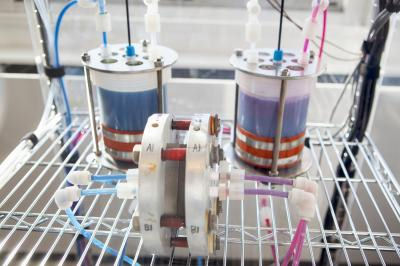
"The whole world of electricity storage has been using metal ions in
various charge states but there is a limited number that you can put
into solution and use to store energy, and none of them can economically
store massive amounts of renewable energy," said researcher Roy G.
Gordon. "With organic molecules, we introduce a vast new set of
possibilities. With these quinones we have the first ones that look
really good."
The technology could have applications at the consumer level, according
to team member Michael Marshak. "Imagine a device the size of a home
heating oil tank sitting in your basement. It would store a day's worth
of sunshine from the solar panels on the roof of your house, potentially
providing enough to power your household from late afternoon, through
the night, into the next morning, without burning any fossil fuels."
Team leader Michael J. Aziz (pictured top of page) added that the next
steps will be to further test and optimize the system and bring it
toward a commercial scale. Aziz said he also expects to achieve
significant improvements in the underlying chemistry of the battery
system. "I think the chemistry we have right now might be the best
that's out there for stationary storage and quite possibly cheap enough
to make it in the marketplace. But we have ideas that could lead to huge
improvements. A safe and economical flow battery could play a huge role
in our transition off fossil fuels to renewable electricity. I'm
excited that we have a good shot at it."


 Emotions affect not only our mental state, but also different areas of
the body. These conscious feelings help individuals fine-tune their
behavior to better match the challenges of the environment. Anxiety may
be experienced as pain in the chest, for example, whereas falling in
love may be associated with warm sensations all over the body. It is
thought that this activation of body areas gets us ready to react
swiftly to dangers, or pleasurable opportunities, present in the
environment around us.